

Who Is Shinji Kanda?
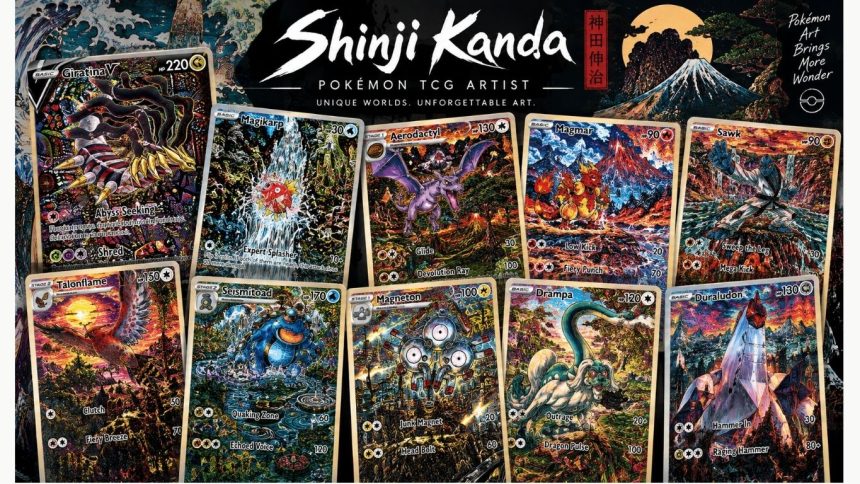
Shinji Kanda is a Japanese visual artist and Pokémon TCG illustrator whose unconventional style has made his cards particularly recognizable among modern Pokémon artwork. The official Pokémon website highlighted Kanda among the artists who debuted during the Sword & Shield series, describing his work in terms of its striking combinations of color, lines, texture, and surreal imagery.
Public biographical information about Kanda is considerably more limited than information about his Pokémon commissions. Independent artist databases describe him as a fine artist associated with Kyoto and report a background in highly detailed drawing, but such biographical details are not as firmly documented by The Pokémon Company itself. For that reason, information about his personal life, education, and career before Pokémon should be distinguished from officially documented TCG credits.
How Did Shinji Kanda Become a Pokémon TCG Artist?
Kanda’s documented Pokémon TCG career began during the Sword & Shield era, when his illustrations appeared in the Brilliant Stars expansion. The official Pokémon website specifically identifies Magmar and Sawk as early Kanda cards and states that his first Pokémon TCG card appeared in Brilliant Stars.
Those relatively modest cards already demonstrated characteristics that would become associated with his work. Instead of presenting a Pokémon against a simple background, Kanda tends to make the creature part of a much larger visual environment. That approach became particularly significant when he was commissioned to illustrate more elaborate cards where the artwork could occupy most or all of the card face.
Brilliant Stars introduced his work to Pokémon collectors
Pokémon TCG: Sword & Shield—Brilliant Stars was released internationally in February 2022. Kanda’s Magmar and Sawk illustrations from the expansion therefore provide useful reference points for tracing his Pokémon career, particularly because Pokémon’s own retrospective coverage identifies them as early examples of his work.
This also clears up conflicting information found in some online collector guides. Some sources describe later Japanese cards as his “debut,” but the official Pokémon material explicitly places Kanda’s first TCG appearance in Brilliant Stars. For a chronological account of his Pokémon work, the official record is the stronger source.
What Makes Shinji Kanda’s Art Style Distinctive?
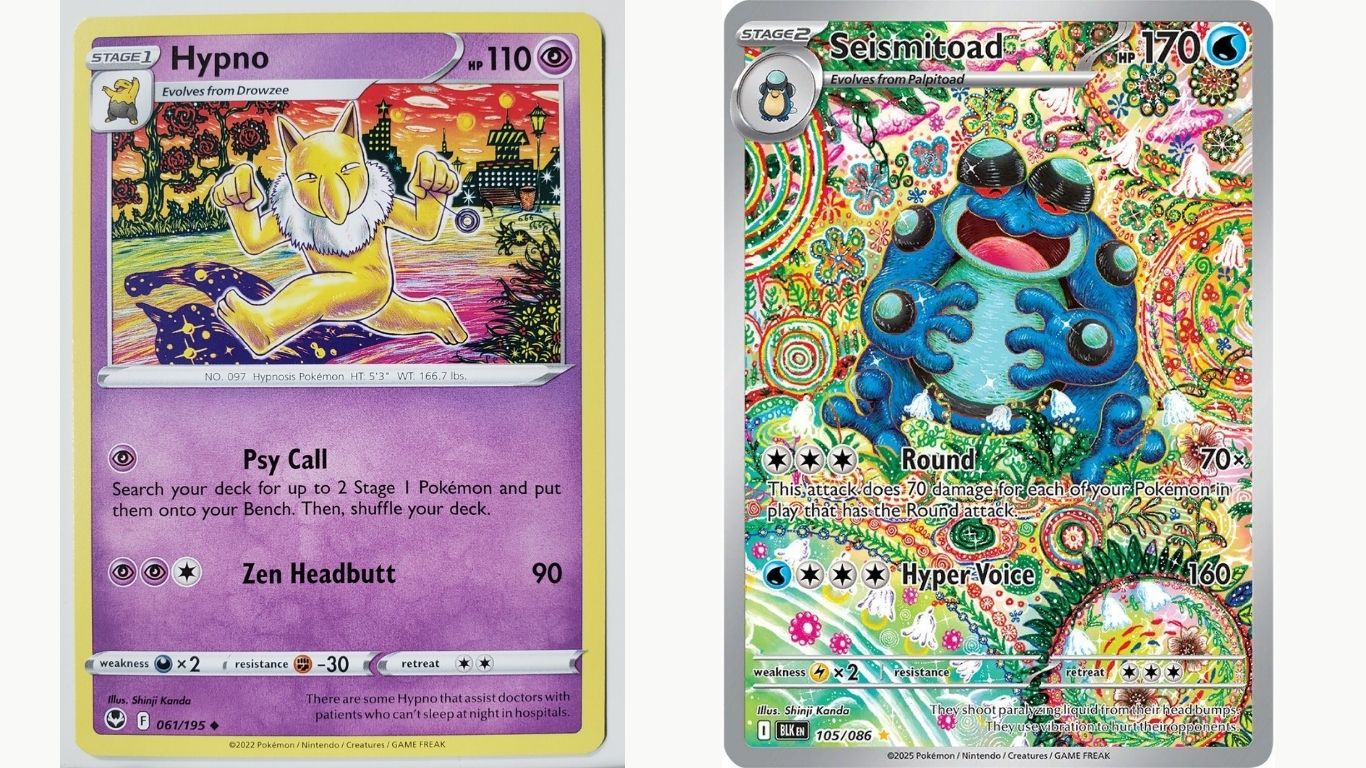
Shinji Kanda’s Pokémon illustrations stand out because they often combine energetic linework, dense environments, extreme contrast, vivid colors, and compositions that appear deliberately chaotic while still directing attention toward the Pokémon. Pokémon’s official coverage has repeatedly singled out these qualities rather than treating his illustrations simply as conventional character artwork.
In its discussion of Scarlet & Violet—Paradox Rift, for example, Pokémon described Kanda’s style as “sketchy” and emphasized his contrast between deep blacks and vibrant colors. His illustrations can contain enough visual information that individual background forms become apparent only after repeated viewing.
His compositions make Pokémon feel part of larger worlds
Many Pokémon cards place the featured creature clearly in the foreground, but Kanda frequently reduces that separation between character and environment. Shapes, vegetation, energy, debris, flames, water, or abstract forms can surround and visually overlap the central subject.
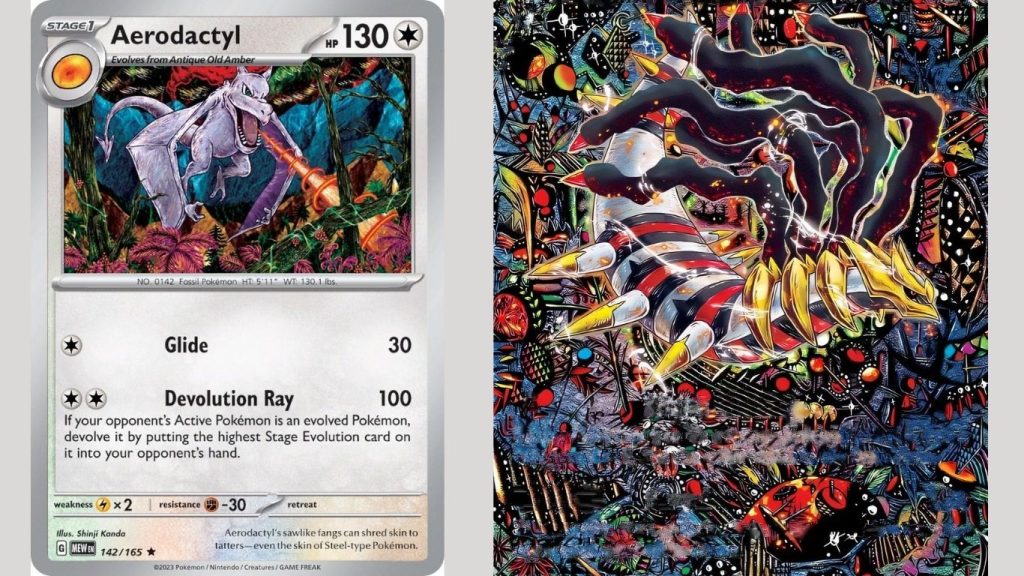
His Giratina V is perhaps the clearest example. The Pokémon appears within a twisting, disorienting environment appropriate to Giratina’s association with the Distortion World, and the official Pokémon website has specifically used the card when discussing how the mysterious setting might appear.
His illustrations reward close inspection
Kanda’s artwork is also notable for its visual density. Individual cards can contain extensive background detail that is easy to overlook at normal trading-card size.
The Pokémon Company’s 2026 discussion of his Talonflame illustration noted the combination of vegetation, lattice-like branches, flames, and embers filling the scene. The example shows how Kanda can create a composition with numerous competing visual elements without allowing the central Pokémon to disappear completely.
What Are Shinji Kanda’s Most Famous Pokémon Cards?
Giratina V and Magikarp are among the most widely recognized Shinji Kanda Pokémon illustrations, although his portfolio includes both special cards and ordinary set cards. His reputation therefore comes from a consistent visual style rather than exclusively from illustrating high-rarity Pokémon.
Giratina V from Lost Origin
Giratina V from Sword & Shield—Lost Origin is one of Kanda’s defining works. Its elaborate composition surrounds Origin Forme Giratina with an almost overwhelming collection of organic and abstract forms, visually reinforcing the strange nature of the Distortion World.
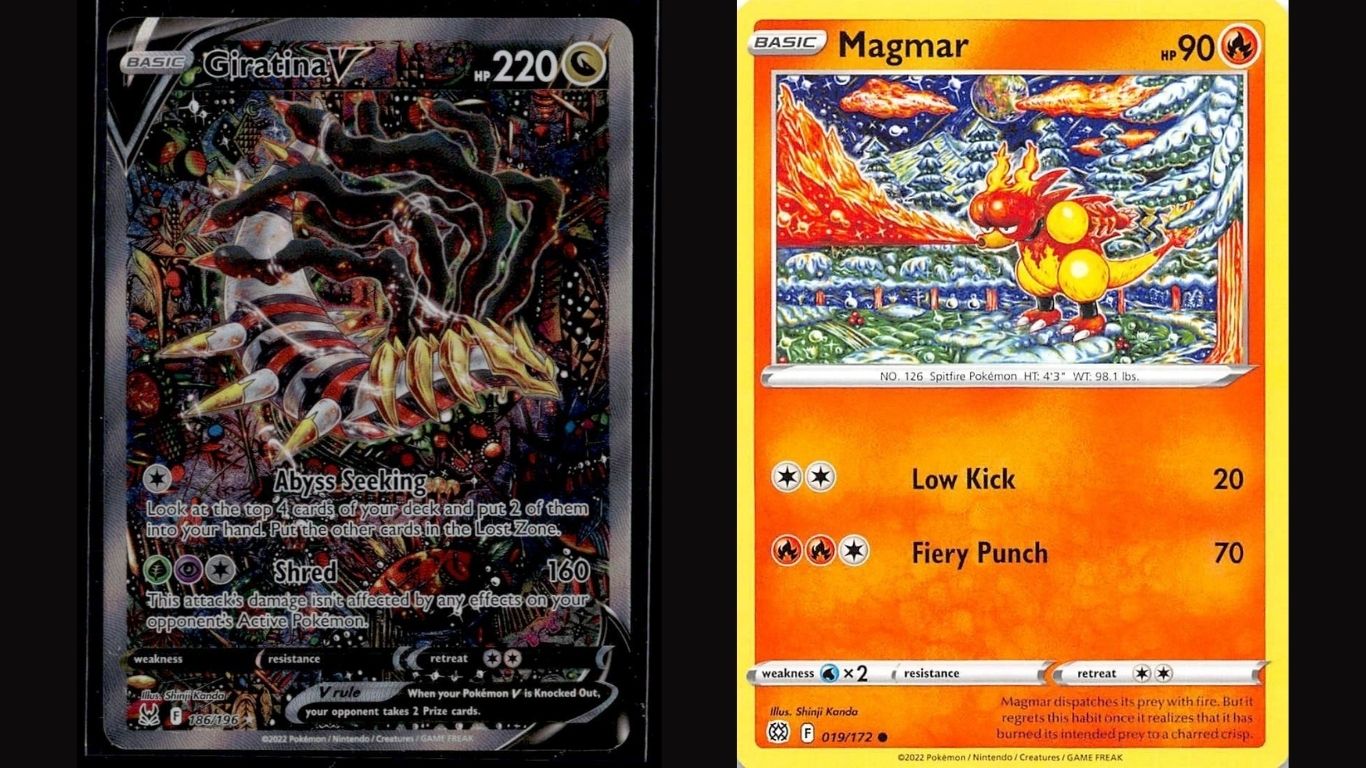
The card also demonstrates why Kanda’s style is particularly effective for unusual Pokémon. Giratina does not simply occupy a setting; its shape becomes intertwined with the visual disorder surrounding it. That relationship between creature and environment gives the illustration a sense of scale and movement that remains noticeable even when viewed at card size.
Magikarp from Paldea Evolved
Kanda’s Magikarp illustration from Scarlet & Violet—Paldea Evolved takes an ordinarily comic Pokémon and places it within an extraordinarily energetic scene. Pokémon’s own coverage introduced the card by observing that viewers can expect something “wild” when Kanda illustrates a Pokémon.
The contrast is part of the card’s appeal. Magikarp is traditionally portrayed as weak or awkward, yet Kanda gives its environment tremendous visual energy, making a familiar Pokémon appear much more dramatic.
Aerodactyl from Scarlet & Violet—151
Kanda also illustrated Aerodactyl for Scarlet & Violet—151. Pokémon’s official analysis compares the prehistoric creature’s destructive appearance to a kaiju and points to the segmented background as one reason Aerodactyl appears particularly enormous.
The card demonstrates another characteristic of his work: scale can be communicated through environmental composition rather than realistic proportions alone. Mountains, sky, vegetation, and energy effects all contribute to making Aerodactyl seem monumental.
Does Shinji Kanda Illustrate Pokémon TCG Pocket Cards?
Shinji Kanda also contributes artwork to Pokémon Trading Card Game Pocket, extending his Pokémon work beyond the physical card game. Current card databases credit him with illustrations appearing across multiple Pokémon TCG Pocket expansions, beginning with the Space-Time Smackdown period.
His digital-game credits include Pokémon such as Spiritomb, Giratina, Ariados, Crobat, Drampa, Whiscash, Bronzong, and others. Because TCG Pocket continues to receive expansions, the exact number of credited illustrations can change over time, making regularly updated card databases more useful than a fixed lifetime total.
Why Is Shinji Kanda Popular With Pokémon Collectors?
Collectors frequently respond to Kanda’s cards because the artist has an immediately identifiable visual language, allowing people to collect his work independently of particular Pokémon, sets, or card rarities. This artist-focused collecting approach has become visible in Pokémon communities, where collectors sometimes build entire binders around illustrations credited to Kanda.
That does not mean every Kanda card is rare or expensive. His portfolio includes ordinary cards alongside highly sought-after illustrations, so a collection based on the artist can contain cards from very different price and rarity levels.
The distinction is useful for new collectors. A card’s illustrator does not determine its rarity, and an expensive Kanda card is not automatically valuable solely because Kanda drew it. Set, card number, rarity, printing, condition, collector demand, and supply all affect secondary-market value.
Is Shinji Kanda Also a Scientist?
The Pokémon illustrator Shinji Kanda should not be confused with Dr. Shinji Kanda, a Japanese scientist at the University of Tokyo who specializes in areas including neuroscience, endocrinology, and neuroendocrinology. They are separate people whose names happen to share the same Romanized spelling.
The academic Shinji Kanda is an associate professor at the University of Tokyo’s Atmosphere and Ocean Research Institute. His laboratory studies physiological regulation in fish, particularly relationships involving the brain, hypothalamus, pituitary gland, reproduction, evolution, and endocrine signaling.
His research record includes work involving medaka, gonadotropin-releasing hormone (GnRH), kisspeptin, pituitary hormones, and the hypothalamic-pituitary-gonadal axis. Current Japanese research records list ongoing projects and publications in these areas through 2026.
This distinction matters when researching the name online. Searches for “Shinji Kanda” can return both Pokémon artwork and scientific publications, so the surrounding terms—such as “Pokémon,” “illustrator,” “University of Tokyo,” or “neuroendocrinology”—are necessary to identify the correct person.
Frequently Asked Questions About Shinji Kanda
What is Shinji Kanda known for?
Shinji Kanda is best known among international audiences as a Pokémon TCG illustrator with a highly detailed, surreal, and visually energetic style. Official Pokémon features have repeatedly highlighted his work and its distinctive use of lines, color, texture, contrast, and complex environments.
What was Shinji Kanda’s first Pokémon TCG set?
Official Pokémon material identifies Sword & Shield—Brilliant Stars as the expansion in which Kanda first appeared as a Pokémon TCG illustrator. Magmar and Sawk were among his illustrations in that set.
Did Shinji Kanda draw Giratina V?
Yes. Kanda illustrated the celebrated Giratina V card from Sword & Shield—Lost Origin, depicting Origin Forme Giratina within an elaborate environment associated visually with the Distortion World.
Did Shinji Kanda draw the Magikarp illustration rare?
Yes. Kanda illustrated Magikarp in Scarlet & Violet—Paldea Evolved, and the official Pokémon website featured the artwork in its coverage of the expansion’s illustration rare cards.
Does Shinji Kanda still create Pokémon artwork?
Yes. Kanda has continued receiving Pokémon illustration credits beyond the Sword & Shield and early Scarlet & Violet periods. In 2026, Pokémon officially highlighted his Talonflame artwork from Mega Evolution—Perfect Order, demonstrating his continuing involvement with the TCG.
Conclusion
Shinji Kanda has developed one of the more recognizable visual styles in the modern Pokémon TCG, combining dense detail, surreal environments, bold contrasts, and energetic compositions in cards ranging from Magmar and Aerodactyl to Magikarp and Giratina V. His continuing Pokémon commissions show that his work extends well beyond a single famous card. Readers exploring Kanda further may want to examine his complete Pokémon TCG illustration history and compare his style with other prominent Pokémon artists.

