

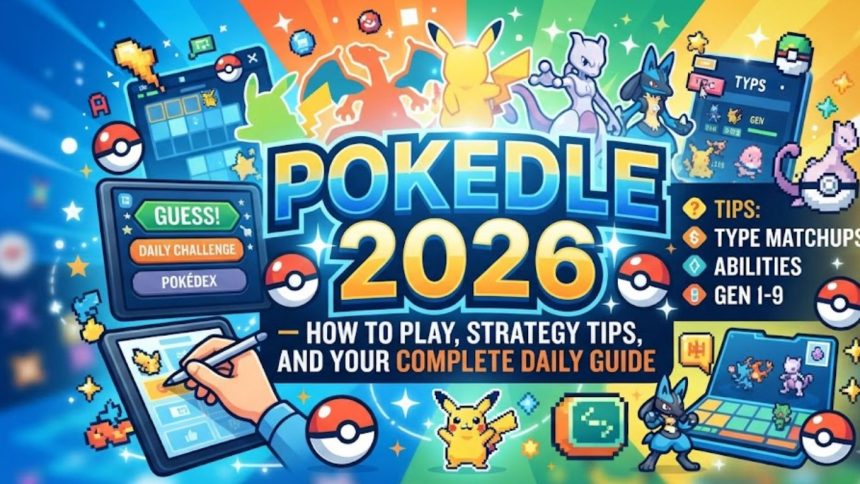
Pokedle is a daily Pokemon guessing game that has quietly built one of the most dedicated followings in the Pokemon community. It takes the satisfying logic-puzzle format of Wordle and applies it to something every Pokemon fan already knows deeply — the characteristics, types, generations, and quirks of hundreds of individual Pokemon. The result is a two-to-five-minute daily challenge that tests knowledge, rewards strategic thinking, and resets every single day with something new.
Whether you discovered Pokedle recently and want to understand how it works, or you have been playing for a while and want to sharpen your solving strategy, this guide covers everything. You will find a clear explanation of the rules, a breakdown of how to read the feedback system, proven strategies for consistent low-guess solves, and answers to the questions that come up most often in the Pokedle community.
What Is Pokedle?
Pokedle is a free, browser-based daily puzzle game inspired by Wordle but built specifically around Pokemon. Rather than guessing a hidden five-letter word, players guess a hidden Pokemon. Each guess reveals how the Pokemon you chose compares to the mystery answer across several attributes — type, generation, evolutionary stage, and others depending on the game mode. The colour-coded feedback narrows down the possibilities with every attempt until you either identify the correct Pokemon or run out of guesses.
The game is fan-made and has no official connection to Nintendo, Game Freak, or Niantic. It draws on publicly available information about Pokemon rather than any proprietary game data. Despite this unofficial status, it has attracted a large and genuinely enthusiastic daily player base within the Pokemon community, with many players treating their daily Pokedle solve as a fixed part of their morning routine.
Like Wordle, Pokedle resets at a fixed time each day, giving every player the same mystery Pokemon to solve. Scores and solve counts can be shared on social media, which has contributed significantly to its word-of-mouth growth. The competitive element — how many guesses did it take you today? — adds a layer of engagement beyond the puzzle itself.
How to Play Pokedle — Rules and Mechanics Explained
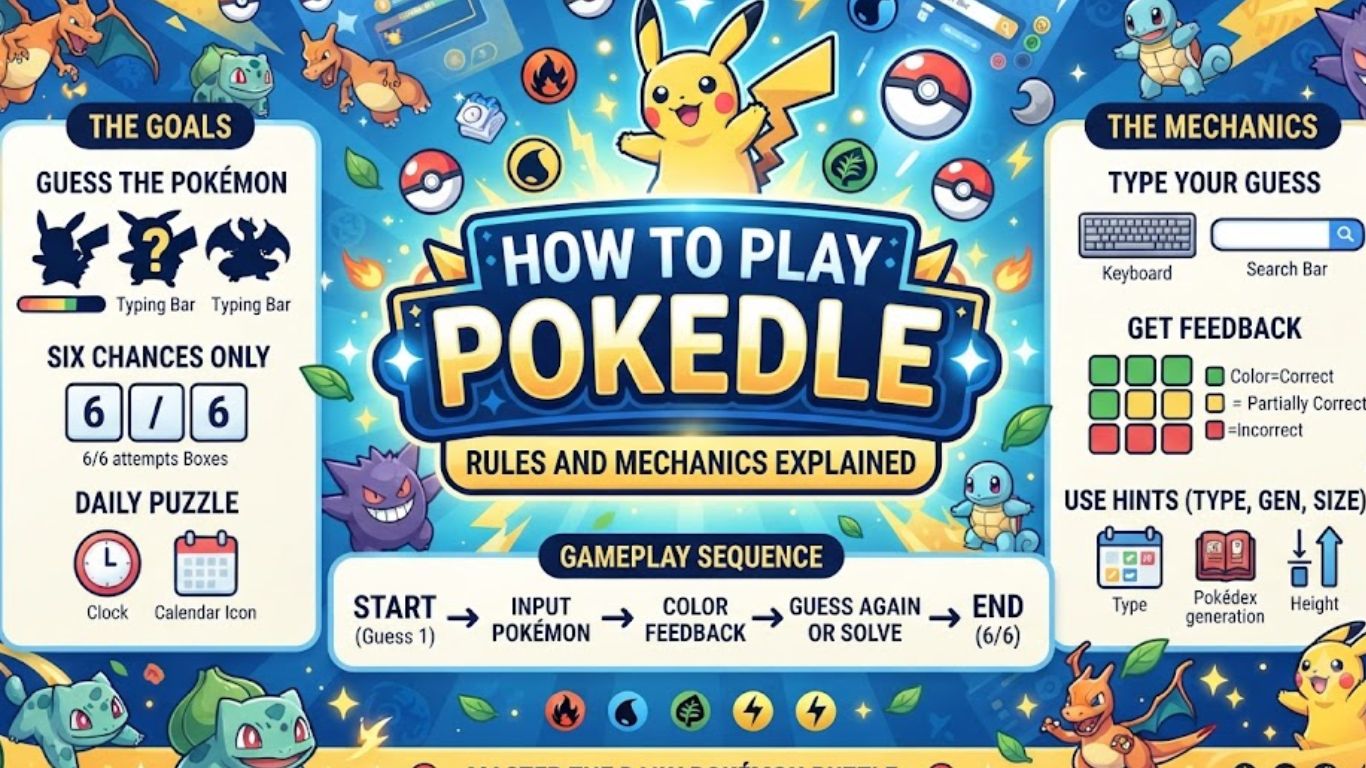
When you open Pokedle, you are presented with a search field. Type the name of any Pokemon from the main series games and select it from the dropdown list. Your chosen Pokemon becomes your first guess and appears as a row of coloured cells, each representing a different attribute being compared to the mystery answer.
The colour of each cell tells you how your guessed Pokemon’s attribute compares to the hidden one. A green cell means that attribute is an exact match. A yellow cell means the attribute is close or partially correct — for numerical attributes like generation, yellow typically indicates you are in the right direction but not exact. A grey or red cell means that attribute does not match and provides no further information about the correct answer.
You continue making guesses, using the information revealed by each row to refine your next choice, until you either identify the correct Pokemon or exhaust your available guesses. Most Pokedle modes allow between six and eight guesses before ending the round and revealing the answer.
Understanding the Attribute Columns
The power of Pokedle as a puzzle comes from having multiple independent attributes revealed simultaneously with each guess. A single guess can confirm or eliminate dozens of Pokemon at once if the feedback aligns across several columns. Understanding what each column is telling you is the foundation of efficient solving.
Type columns reveal whether the mystery Pokemon shares a primary or secondary type with your guess. A green result here immediately narrows the pool to all Pokemon sharing that type. Generation columns reveal which numbered generation the mystery Pokemon belongs to, either confirming your guess or indicating higher or lower. Evolutionary stage columns reveal whether the mystery Pokemon is a base form, middle evolution, or fully evolved — a powerful filter given how differently these groups are distributed across the Pokedex. Legendary and mythical status columns confirm or rule out whether the mystery Pokemon belongs to those rare categories, which can instantly eliminate or confirm a large portion of possibilities depending on your guess.
Proven Strategies for Solving Pokedle in Fewer Guesses
Approaching Pokedle randomly — guessing whatever Pokemon comes to mind — will occasionally produce a lucky fast solve but makes consistent low-guess performance impossible. The players who regularly solve Pokedle in two or three guesses are using deliberate strategies built around information efficiency.
The most important principle is to maximise information per guess rather than trying to guess the answer directly. Your first guess should be a Pokemon chosen specifically because it will reveal the most useful feedback, not because you think it might be correct. A common, mid-generation, single-type, non-legendary Pokemon from one of the middle generations provides a wide range of attribute information regardless of what the answer turns out to be. This kind of calibration guess gives you the broadest possible feedback from a single attempt.
Use generation as your primary filter from the start. There are nine main series generations, and knowing whether the mystery Pokemon is from generations one through three versus six through nine eliminates hundreds of possibilities immediately. Once you have confirmed the generation within a range of two or three, your subsequent guesses can focus on type and evolutionary stage to narrow the remaining pool further.
Pay close attention to type elimination. Every grey type cell rules out a large group of Pokemon simultaneously. If you have confirmed the mystery Pokemon is not Water type, not Psychic type, and not Normal type across your first two guesses, the remaining pool contracts dramatically. Building a mental map of which types have been eliminated is more valuable than focusing only on what might be correct.
Evolutionary stage is an underappreciated filter. Fully evolved Pokemon make up a minority of the total Pokedex but represent a disproportionate share of well-known species. If an early guess confirms the mystery Pokemon is a fully evolved, single-type Pokemon from a specific generation, your remaining shortlist often contains only a handful of candidates. Work through them systematically rather than guessing randomly within the confirmed range.
Pokedle Game Modes — More Than One Daily Challenge
.
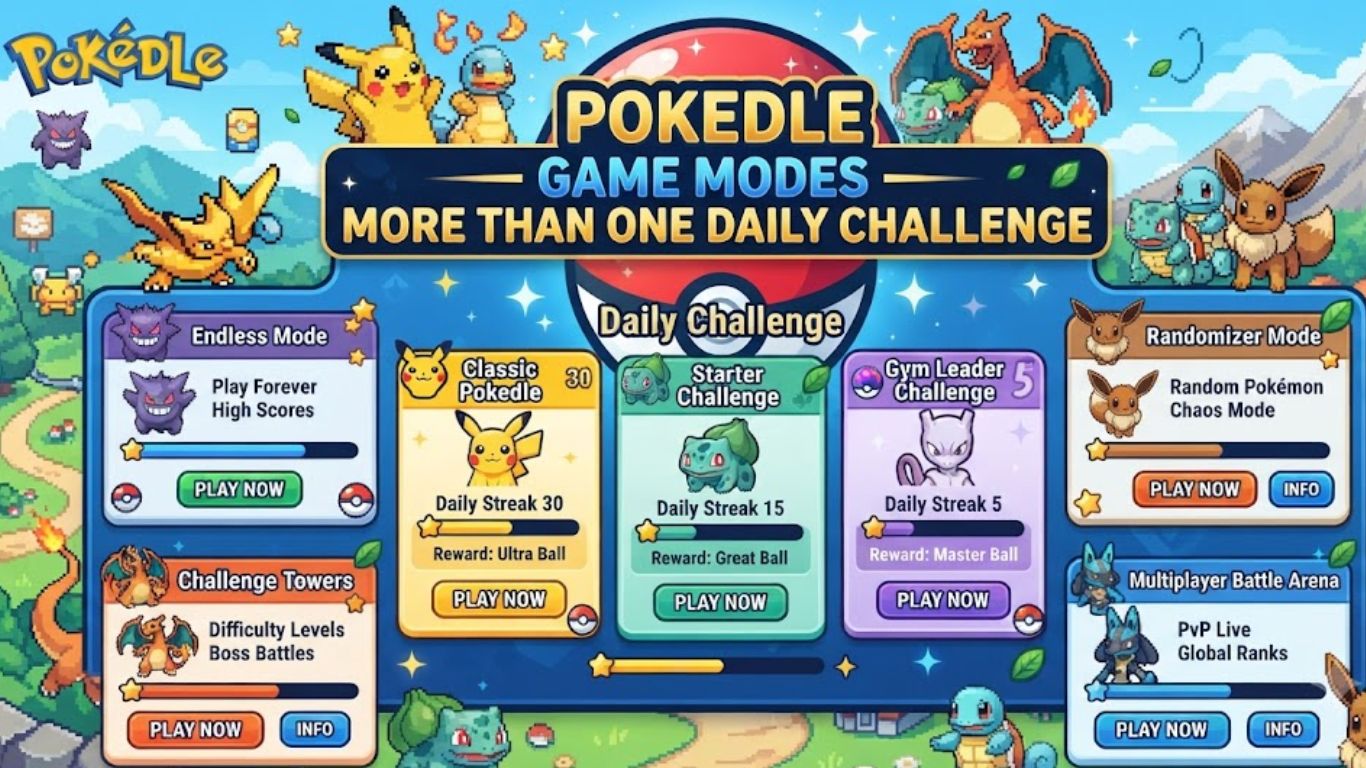
The original Pokedle format is the attribute-comparison mode described above, but the game has expanded to include several distinct modes that test different aspects of Pokemon knowledge. Many dedicated players complete multiple modes each day.
The silhouette mode presents an outline of the mystery Pokemon against a blank background and challenges you to identify it from its shape alone. This mode rewards players with strong visual familiarity with Pokemon designs — a very different skill from the analytical reasoning the classic mode demands. Rare and obscure Pokemon with distinctive silhouettes are notoriously difficult in this mode, while iconic shapes like Pikachu or Gengar are quickly identified even in their outline form.
Move-based variants provide the name of a move or ability associated with the mystery Pokemon as the primary clue. Solving this mode efficiently requires knowledge of the competitive and standard move pools across the Pokedex — a much more specialised knowledge base than general type and generation awareness. Players who follow competitive Pokemon formats tend to perform well here, while more casual players may find it significantly more challenging than the classic mode.
Cry or sound variants, where available, play the audio cry of the mystery Pokemon and challenge you to identify it by ear. This mode is genuinely difficult for most players but rewarding for those who have spent time with the original Game Boy and Game Boy Advance titles where Pokemon cries were a consistent part of the experience.
Why Pokemon GO Players Specifically Enjoy Pokedle
For active Pokemon GO players, Pokedle offers something the main game does not: a focused, knowledge-based challenge that takes only a few minutes and delivers a complete experience within that window. Pokemon GO sessions can vary enormously in length depending on events, raid availability, and local community activity. Pokedle fits naturally into the gaps — waiting for a raid lobby to fill, between egg hatches, or during a commute when opening the main game for a full session is not practical.
There is also a genuine knowledge transfer between Pokedle and Pokemon GO performance. Players who engage with Pokedle regularly reinforce their familiarity with Pokemon types, evolutionary lines, and generational groupings. This translates directly into faster decision-making in Pokemon GO raid counter selection, quicker recognition of which Pokemon are worth assessing for PvP potential, and a broader instinctive grasp of the Pokedex that makes the main game more enjoyable overall.
Frequently Asked Questions — Pokedle
Is Pokedle free to play?
Yes. Pokedle is completely free to play in any modern web browser. No account registration, download, or payment is required. Open the site and start playing immediately.
How many guesses do I get in Pokedle?
Most Pokedle modes allow between six and eight guesses before the round ends and the answer is revealed. The exact number varies slightly depending on the specific mode and version you are playing.
Does Pokedle include Pokemon from all generations?
The classic Pokedle mode includes Pokemon from all nine main series generations. Some variant modes or themed editions focus on specific generations or subsets of the Pokedex. Check the mode description before starting if you want to know the specific scope of a particular variant.
Can I play previous days’ Pokedle puzzles?
Some versions of Pokedle include an archive or practice mode allowing access to previous daily puzzles. Check the game’s main menu or settings for historical puzzle options, as availability varies between different Pokedle implementations.
Is Pokedle officially connected to Pokemon GO or Nintendo?
No. Pokedle is a fan-made game with no official connection to Niantic, Nintendo, or Game Freak. It uses Pokemon names and characteristics as its subject matter but is an entirely independent project created by members of the Pokemon fan community.
What time does Pokedle reset each day?
Pokedle typically resets at midnight in the player’s local time zone, though the exact reset time can vary slightly depending on the specific version of the game. If a puzzle seems unchanged after midnight, a hard refresh of the browser page usually loads the new daily challenge.
Internal linking suggestion: Link the phrase ‘Pokemon types’ to your type guide or raid counter index. Link ‘competitive Pokemon’ to any PvP or Battle League content on your site. Link ‘Pokemon GO raid’ to your current raid guide.

